Inclusion Stones
Inclusion Gems
Faceted gemstones that contain distinct inclusions of other mineral species are geological snapshots—tiny, three-dimensional records of the conditions under which the host crystal grew. These inclusions form when a developing crystal engulfs nearby minerals or fluids during growth, preserving them intact as the gemstone continues to crystallize. Depending on the environment, these inclusions may appear as sharply defined crystals, growth-zoned clusters, metallic platelets, or fluid-filled cavities, each reflecting the host’s temperature, pressure, and chemical history.
Their rarity stems from the precise conditions required: the included mineral must crystallize before or during the host’s formation, must be stable within the host’s chemistry and pressure regime, and must be captured without being dissolved or distorted. Most crystals grow in environments too dynamic or too chemically incompatible to preserve such inclusions cleanly, making well-formed included gems intrinsically uncommon.
These gems are uniquely valued because each inclusion creates a natural, unreproducible composition—part mineral specimen, part gem. Faceting transforms these internal features into aesthetic focal points: rutile “silk” weaving through sapphire, pyrite cubes suspended in quartz, or hematite platelets glittering in garnet. Rather than detracting from clarity, these inclusions enhance character, offering collectors and gemologists a window into deep-Earth processes while giving each stone a singular visual identity.
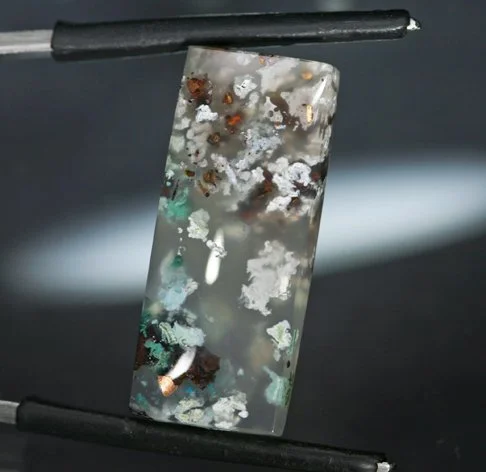
Color: Various
Clarity: Translucent
Origin: Indonesia
Cut: Rectangular Cabochon
Treatments: None
Measurements: 27.3 x 11.5 mm
From a relatively new deposit comes this example of an extremely attractive and popular new variety of Chalcedony. The colors are exceptional - bright blues and greens - while the truly special aspect is the visible inclusions of Copper. This adds a texture and reflectivity that just serves to make this type even more appealing. Great look and excellent size.
$85 total
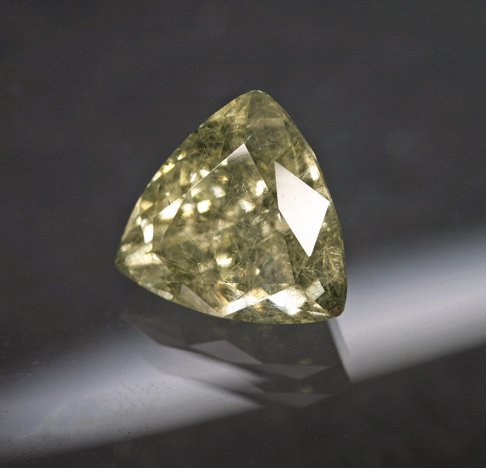
Color: Medium Light Yellow
Clarity: Heavily Included
Origin: Niaslo, Pakistan
Cut: Triangle
Treatments: None
Measurements: 7 mm
An intriguing one off gem from the area around Shigar. Otherwise entirely clean, the gem contains a veritable nest of Byssolite fibers (typically an amphibole mineral) that swirl and reflect throughout the entire stone. Nicely cut and a fine size to appreciate the effect of the Byssolite. Endlessly fascinating, one of the more interesting inclusion gems we have seen of late.
$40 / carat - $206 total
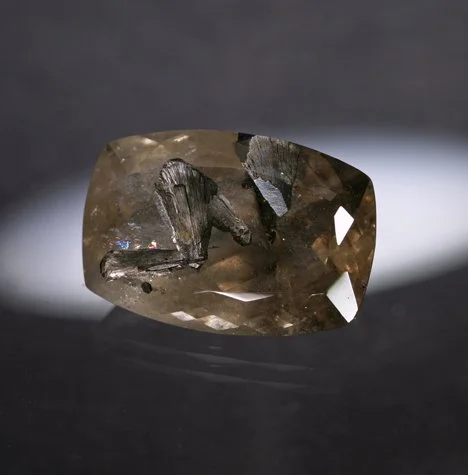
Color: Medium Dark Brown
Clarity: Heavily Included
Origin: Russia
Cut: Rectangular Cushion
Treatments: None
Measurements: 21.9 x 14.8 mm
A really fascinating and unique inclusion gem from a single Russian crystal. The wispy blades of Arsenopyrite are centered in the stone and have a fantastic texture and luster that catches the light. Great size for a stone like this and very, very well centered and cut.
$8 / carat - $150 total


Color: Colorless
Clarity: Slightly Included
Origin: Madagascar
Cut: Rectangular Step
Treatments: None
Measurements: 16.5 x 9.3 mm
One of these great inclusion stones from Madagascar - completely colorless Quartz framing a single bold and well formed Fluorite octahedron. Two points worthy of mention here - the quality of the cutting, much higher than is usually given Quartz. Secondly, the attractive blue-purple color of the Fluorite which makes for such a fine and aesthetic contrast. A great size and quite rare to have a single, great crystal that is largely transparent like this one.
$35 / carat - $342 total


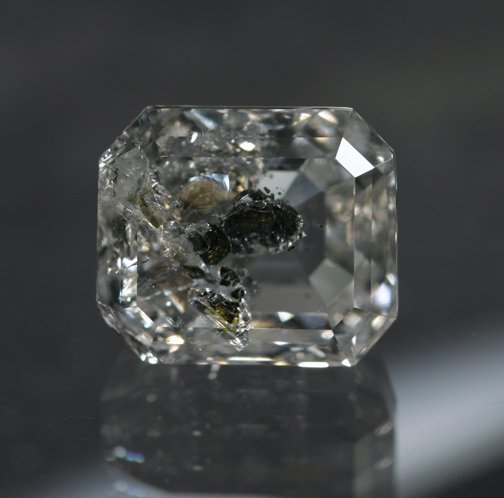
Color: Colorless
Clarity: Heavily Included
Origin: Paksitan
Cut: Rectangular Step
Treatments: None
Measurements: 12.1 x 10.5 mm
No doubt you have seen the very fine doubly terminated crystals of this material, it has been somewhat ubiquitous in the mineral world for several years. Despite this, there is always dearth of faceted stones - the pockets of bitumen and liquid petroleum make cutting rather difficult. Very happy to have found this one, the cutting is lovely and the petroleum pocket is highly fluorescent as you might suspect. Fun stone.
$125 total
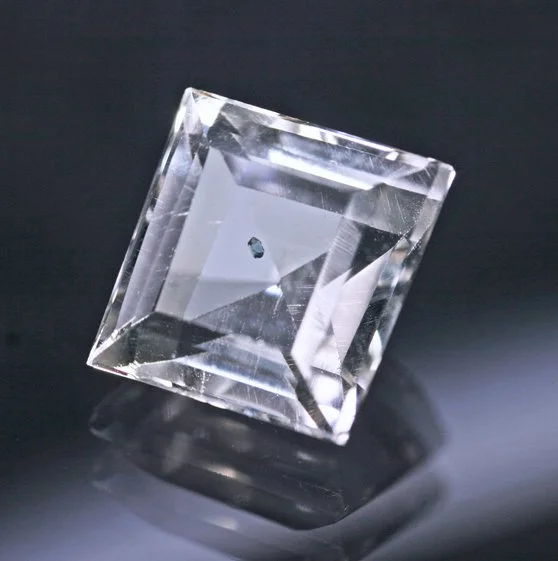
Color: Colorless
Clarity: Slightly Included
Origin: Brazil
Cut: Rectangular Step
Treatments: None
Measurements: 7.9 x 7.6 mm
A striking inclusion gem. Colorless Quartz with a single, perfectly formed gemmy blue Apatite crystal suspended under the table. One of the most aesthetic examples we have seen, just pure joy for the gem enthusiast. .
$175 total
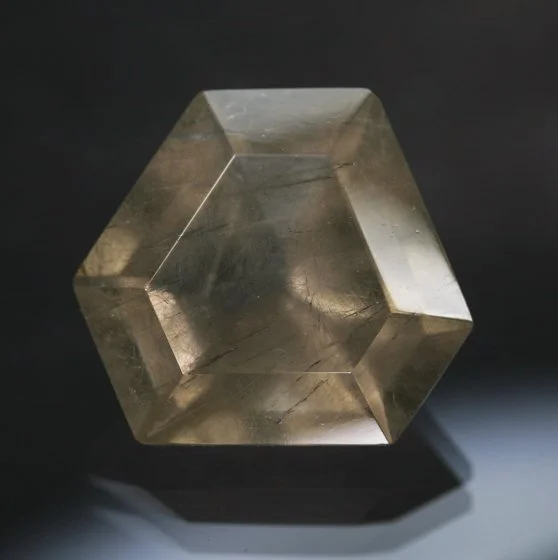
Color: Light Brown
Clarity: Heavily Included
Origin: Żółkiewka, Gmina Strzegom, Świdnica County, Lower Silesian Voivodeship, Poland
Cut: Triangular Step
Treatments: None
Measurements: 18.3 x 16.3 mm
A highly unusual mineral combination from what is apparently the only source - Swidnica County, Poland. The rare mineral Bavenite is present here as the thin wispy needles throughout the Quartz host. A one-off stone from a collection and certainly one of the few from this deposit.
Color: Colorless
Clarity: Heavily Included
Origin: Brazil
Cut: Rectangular Step
Treatments: None
Measurements: 15.3 x 9.3 mm
We always enjoy seeing what new species with show up as an inclusion in Quartz. It hosts such a variety of other minerals that it seems each year there is something new and interesting. A few years ago, it was a limited find in Brazil that produced colorless Quartz with extremely well-formed (and entirely gem grade) crystals of Sphalerite. These wonderful triangular shapes float in the Quartz host, the light catching their deep brown-red color. Really lovely and quite fascinating - there was very little of this material mined.
$40 / carat - $225 total